Ashwamedha Yagna Story by Lord Rama
This story is an original retelling, written in our own words, inspired by a video from the Tilak YouTube channel.
The Noble Resolve for the Yagna
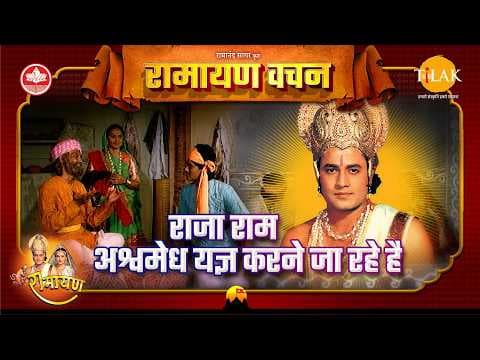
The land of Ayodhya was once again set to witness sacred deeds and divine events. Lord Rama, now seated on the throne of Ayodhya, resolves to perform a great yagna. This was no ordinary ritual, but an Ashwamedha Yagna, considered extremely virtuous and significant. The purpose of this yagna was not merely to establish superiority over the Rajasuya Yagna, but to further consolidate his position as a Chakravarti Samrat (emperor of emperors) and to set an ideal for his subjects. As a descendant of King Dasharatha, Rama also had the responsibility to uphold his lineage. He decided to organize this yagna in such a way that its glory would reach the heavens, and its comparison would be impossible in all three worlds. This yagna was not just a political declaration, but also a symbol of Rama's righteous and subject-loving nature. He ordered that all necessary provisions for the completion of this yagna be meticulously attended to.
Lakshman and Hanuman's Contribution
In the success of the yajna, Sri Ram’s brother Lakshman and supreme devotee Hanuman played an extremely important role. Lakshman, known for his loyalty and bravery, assisted Sri Ram in smoothly managing the yajna's arrangements. He ensured that all priests and guests received proper respect and faced no inconvenience. On the other hand, Hanuman, with his boundless strength, intelligence, and devotion, was playing a major role in the yajna's security and the horse's journey. He could reach anywhere with the speed of wind and was capable of facing any challenge. He played a vital role in identifying and overcoming potential obstacles in the horse's path. Hanuman’s very presence boosted the morale of the warriors. Sri Ram had complete faith in him and knew that Hanuman would not disappoint him under any circumstances.
The Horse's Abduction and Ram's Fury
The yajna was progressing towards completion when an unexpected event occurred. The horse, which was on its conquest journey, was abducted for an unknown reason. This was not only an obstacle to the yajna, but also a question mark on Sri Ram's emperorship and his honor. Sri Ram became extremely angry. He ordered his brave warriors to find and retrieve the horse. This anger was natural, as the protection of the yajna horse is paramount for a king. If the horse did not return safely, the yajna would be considered incomplete, and Sri Ram's Ashwamedha Yajna would also remain unfinished. This incident caused concern for everyone, and a wave of anxiety spread through Ayodhya. Sri Ram instructed all his capable warriors to recover the horse at any cost.
The Amazing Valor of Luv and Kush
When Sri Ram's warriors set out to find the horse, they encountered two astonishingly radiant boys in the forest. These boys were none other than Sri Ram's own sons, Luv and Kush, who were being raised in the ashram of sage Valmiki. These boys not only stopped the horse, but they also defeated all the valiant warriors of Sri Ram's army with their prowess. Despite their young age, Luv and Kush displayed exceptional bravery and combat skill. They disarmed great warriors with their arrows and forced them to retreat. Sri Ram’s brave soldiers, famous for their valor, could not stand before these boys. This scene was extremely astonishing, as Sri Ram himself was the performer of this yajna, and his own sons were protecting his yajna, even though they were unaware of each other.
Hanuman Confronts Luv and Kush
When Rama's army was defeated by Luv and Kush, the mighty son of the wind, Hanuman, was sent forth. Hanuman, renowned for his strength and wisdom, faced Luv and Kush. He observed that these two boys were exceptionally radiant and powerful. Hanuman attempted to stop the two children, but Luv and Kush engaged Hanuman in battle themselves. Hanuman, who had once devastated Ravana's entire army, found himself fighting these two young boys. Although Hanuman was immensely strong, he also harbored feelings of affection for the children in his heart. He was astonished by their valor. Ultimately, after the combat, Hanuman realized that there was a special divinity within these boys. He recognized them as aspects of Lord Rama himself, in the form of children.
Lord Rama and the Horse's Reunion
Luv and Kush had taken Lord Rama's sacrificial horse to their ashram and kept it there. When Lord Rama learned that his own sons had abducted the horse meant for his sacrifice, he was astonished. He dispatched his army once more, and this time, he himself set out to meet Luv and Kush. Upon seeing the boys, Lord Rama was reminded of his wife, Sita, who was their mother. Lord Rama recognized the valor of Luv and Kush and the purity of their speech. He sought to recover the horse to uphold the sanctity of his sacrifice. Eventually, through the intervention of Sage Valmiki, and with Sita herself appearing, the truth was revealed to all. Lord Rama expressed immense joy upon reuniting with his sons and wife. The sacrifice was completed, and the horse was safely retrieved.
The Spiritual Significance of the Sacrifice
This sacrifice was not merely a ritual or a Rajasuya ceremony; it was a symbol of Lord Rama's devotion to dharma, his love for his subjects, and his righteousness. This sacrifice proved that Lord Rama adhered to dharma, rising above all personal ties. The valor displayed by Luv and Kush during the sacrifice, who were indirectly aspects of Lord Rama himself, demonstrated that God himself can incarnate to protect dharma. This episode also highlights the power of devotion and the complexity of divine play. Even though Lord Rama was an ideal king for his subjects, he was also bound by his duties as a father. This sacrifice also taught that truth ultimately prevails, no matter the obstacles. This sacrifice was greater than all the rituals performed by gods like Indra, Varuna, or Chandra, as it was performed by an avatar of Lord Vishnu himself, with complete devotion and adherence to dharma.
Was it envy from Indra, Varuna, and Chandra?
This sacrifice, as described in the Uttara Ramayana, was so grand and sacred that it could not be compared even to the sacrifices of the gods in the heavenly realm. Deities like Indra, Varuna, and Chandra, who were themselves knowledgeable about and participants in great sacrifices, were astonished by its magnificence and divinity. It is believed that sometimes envy or astonishment can arise in the minds of gods, especially when a human or an avatar performs an act that surpasses their own capabilities. Although it is not explicitly stated that the gods felt envy, the mention of this episode makes it clear that this sacrifice by Shri Ram was an example not only for humans but also for the gods themselves. It demonstrates that through true devotion, loyalty, and adherence to dharma, a person can attain a status equal to or even higher than the gods. This sacrifice was considered superior to the rituals of the heavenly realm because it had no place for ego; only dharma and truth held importance.
FAQ
What is an Ashwamedha Yajna?
An Ashwamedha Yajna is an ancient Vedic ritual in which a horse is released for a year-long conquest (digvijaya). The king's army accompanies this horse for its protection. If anyone obstructs the horse, they must be defeated in battle. The yajna is completed when the horse returns safely.
Who were Lava and Kush?
Lava and Kush were the sons of Shri Ram and Mother Sita. They were raised in the ashram of Maharishi Valmiki and it was they who seized the horse from Shri Ram's Ashwamedha Yajna, which led to Shri Ram meeting them.
Why did Shri Ram perform this sacrifice?
Shri Ram performed this sacrifice to solidify his position as a Chakravarti Samrat (universal emperor), to set an ideal for his subjects, and to prove that his righteous conduct was superior to the sacrifices performed by the gods in the heavenly realm.
Why was this sacrifice compared to the sacrifices of Indra, Varuna, and Chandra?
This sacrifice was deemed incomparable because it was performed by Shri Ram, an avatar of Lord Vishnu himself, with complete devotion, adherence to dharma, and truth. Its divinity and sanctity were so great that it could not be compared to any sacrifice in the heavenly realm.
Frequently Asked Questions
What is the Ashwamedha Yagna?+
The Ashwamedha Yagna is an ancient Vedic ritual where a horse is released for a year for conquest. The king's army escorts this horse. If any king or warrior stops the horse, they must be defeated in battle. The yagna is complete when the horse returns safely.
Who were Luv and Kush?+
Luv and Kush were the sons of Lord Rama and Mother Sita. They were raised in the ashram of Maharishi Valmiki and it was they who captured the horse of Lord Rama's Ashwamedha Yagna, leading to Rama meeting them.
Why did Lord Rama perform this yagna?+
Lord Rama performed this yagna to solidify his position as Chakravarti Samrat, to set an example for his subjects, and to prove that his righteous conduct was superior even to the yagnas performed by the gods in heaven.
Why is this yagna compared to the yagnas of Indra, Varuna, and Chandra?+
This yagna is considered incomparable because it was performed by Lord Rama, an avatar of Lord Vishnu himself, with complete devotion, righteousness, and adherence to truth. Its divinity and purity were so immense that it could not be compared to any yagna in the celestial realms.